Enterprise AI: The Systems of Work
June 9, 2026 · Hari Pudusseri

TL;DR:
- Most enterprise systems and processes are designed to record work and make decisions auditable, not to help people make better decisions next time.
- The judgment that drives these decisions lives in emails, docs, meetings, chat threads, and people’s heads. When people leave, it often leaves with them. Whatever limited traces humans leave behind, get archived into systems that become useful only during audits and lawsuits.
- The enterprise AI opportunity is way bigger than better productivity assistants and smarter data exploration. It is about building a Judgment Layer that capture reasoning during the flow of work, govern it properly, and help the organization learn from itself over time.
- This system will only work if employees trust it. If it feels like a knowledge extraction pipeline designed to turn employee judgment into automation or headcount reduction, people will withhold context or contribute low-quality noise.
- Context has to be contributed during the flow of work. That requires enterprises to move from passive recording, and after-the-fact documentation to building systems that allow active contribution while work is happening. A value exchange between the system and its users (employees) has to exist and be explicit. The system should help people learn faster, build new skills, move toward higher-value work, improve judgment, and reduce rework.
- Governance is the other half of the problem. Enterprise judgment is not a public asset. It is permissioned, contextual, and constantly changing. Enterprises need clear rules and systems for what should be remembered, who can see it, how long it should matter, and what becomes durable organizational memory.
If you have the time, interest, and patience, read on.
The Long Version
Until recently, and largely even now, Enterprise AI is being sold as a productivity revolution - faster work, more output, fewer people. But productivity is only part of the story. Every day, employees make thousands of judgment calls that never become part of institutional memory. The reasoning behind the decision, and the action that followed, is often buried in emails, documents, meeting notes, chat threads, and in people’s heads.
Enterprise AI becomes a compounding advantage when it helps companies preserve and use this memory. That is what Enterprise AI systems should be building toward.
What today’s enterprise systems actually do
Enterprise systems are very good at preserving outcomes and surprisingly bad at preserving the reasoning behind them. They play a limited role in the decision itself, beyond supplying data and insights to the people involved. The ERP does not care how many conversations happened before a purchase order was approved. The CRM does not care about the internal debate that shaped a pricing decision. A ticketing system tracks that an exception was granted, but not the tradeoffs behind that exception.
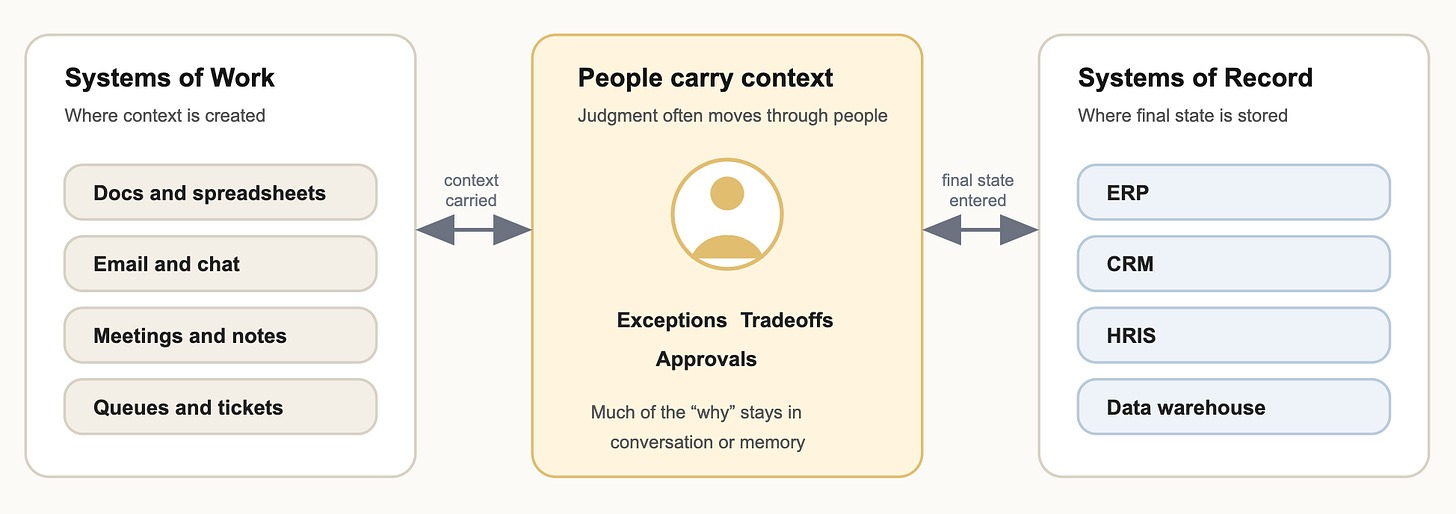
A simplified mental model is that people spend their days shuttling between Systems of Work and Systems of Record. For decades, humans have acted as the integration layer between systems of record and systems of work. They carry context from meetings into systems, explain exceptions that do not fit the workflow, and reconnect decisions to the reasoning behind them. When they change teams, retire, or leave the company, much of that context leaves with them.
For those who prefer pictures to words, here’s a simple illustration [thanks to AI]:
The Incentives Problem that created these systems
Enterprise software, and the processes around it, are the result of a multi-sided incentive problem. Over time, those incentives have shaped an industry optimized for legibility, standardization, and governance.
To understand why enterprise systems look the way they do, it helps to look at the key parties involved in shaping them.
Start with the buyer.
The buyer is usually a coalition - of business teams who want capability, tech teams who want architectural fit, security teams who want risk reduction, legal and privacy teams who want defensibility, finance teams who want cost discipline, and procurement teams who want commercial leverage. Most enterprise review processes are very good at assessing objective fit. Is the system secure? Does it integrate with the architecture? Is the contract defensible? Are the commercials reasonable? Does it check the box on a list of boilerplate features? Enterprise software can pass every review and still miss the lived reality of the work that drives outcomes.
The vendor has their own incentives as well.
Vendors optimize for packaging and monetization. Every company ends up with its own version of the same software universe with different sets of modules licensed, customizations built, integrations maintained, and workflows enforced.
Then there is the employee (the end user).
In many ways, end users are the most important part of this equation because they are the ones dealing with the reality of the work. Their job is about getting the work done while satisfying what the system demands. When the workflow does not fit the situation, the employees adapt around the system. They create spreadsheets, shared documents, chat threads, local trackers, meeting notes, task management systems, and side processes.
Almost nobody inside the system is behaving irrationally. Each party is optimizing for what the system asks of them - they are doing their job. When you combine all of these incentives, a gap naturally emerges between the work that happened and the systems that are expected to capture it. This is where organizational learning leaks - decisions are repeated, context is rediscovered, and judgment walks out the door as people move teams or leave the company.
The Opportunity: Building the Judgment Layer
There is a growing conversation around “context graphs” and AI systems that accumulate context around decisions, exceptions, approvals, and precedent over time. I think that framing is directionally right, but the harder question is how this actually gets built inside a governed enterprise.
The answer is not to scrape documents, record jobs-to-be-done, and call the result a graph. The system has to capture reasoning as work gets done, in the unstructured systems and informal conversations where judgment is actually formed. Software systems close to those collaboration workflows have an advantage because they sit where context is created. That is where the layer has to live.
I understand that this sounds useful in theory. There are many problems to solve before it can become real. I will focus on what I believe are the two most important ones.
The first is technical. Enterprise judgment is not a public asset. It is permissioned, contextual, and constantly changing. A useful Judgment Layer has to know what should be remembered, who should be allowed to see it, how long it should remain relevant, when it should no longer influence future decisions, and how it connects to the larger enterprise workflow.
Permissioning, lineage, retention, auditability, and governance are difficult engineering challenges at scale. But technical problems have a way of becoming solvable once they are clearly defined. The successful companies in this space will be the ones that solve this problem first.
The second problem is human. A Judgment Layer only becomes valuable if employees are willing to contribute context to it, work through it, and trust the outcomes it produces. That requires more than new technology. It requires new incentives, and new ways of working.
Aligning the incentives and ways of working
We talked about the buyer, the seller, and the user as the three parties involved in the mix of how enterprise systems come about. AI changes the relative importance of the three parties.
The frontline employee is no longer just a user of the system. They become one of the primary sources of context the system needs to function well. The quality of the system becomes directly tied to the quality of the context it receives.
Employees will naturally worry that AI systems are knowledge extraction pipelines. The system that takes what they know, turns it into tokens, and sells it back to the company as output. This fear is rational, and a trust problem every enterprise has to grapple with.
That is why organizations have to be very intentional about how they introduce AI into work. The value proposition has to be clear to the employees. Does it support learning and reskilling? Does it help employees move toward higher-value work? Does it improve judgment? Does this reduce rework?
If the answer is ‘no’ to any of these questions, adoption will be fragile. Otherwise, the system stands a chance.
In short - Context cannot be harvested. It has to be contributed willingly and naturally. You risk accumulating slop if you try otherwise.
Making Judgment Durable
First, the Judgment Layer has to let employees capture context in the flow of work, and ensure that the value exchange remains equitable. This cannot be yet another eval or skills database that the employees are expected to fill up, and expect to provide value in the future. It has to sit inside the flow of work and quickly start providing immediate value. Humans should work through it, not around it or after the fact.
Second, the system should enable identifying and governing what deserves to become durable organizational memory. Not every conversation, decision, or exception should influence future decisions. It would not surprise me if this becomes a new enterprise job role itself over time.
The systems of record still matter. They remain essential infrastructure. But they risk being obscured into a backend database through this transition. That is uncomfortable for the enterprise software companies built around those systems, but it also points to the opportunity ahead for them.
So, that I believe, is the new front door of enterprise work - and where Enterprise AI matures beyond chatbots, daily summaries, and productivity theater.